

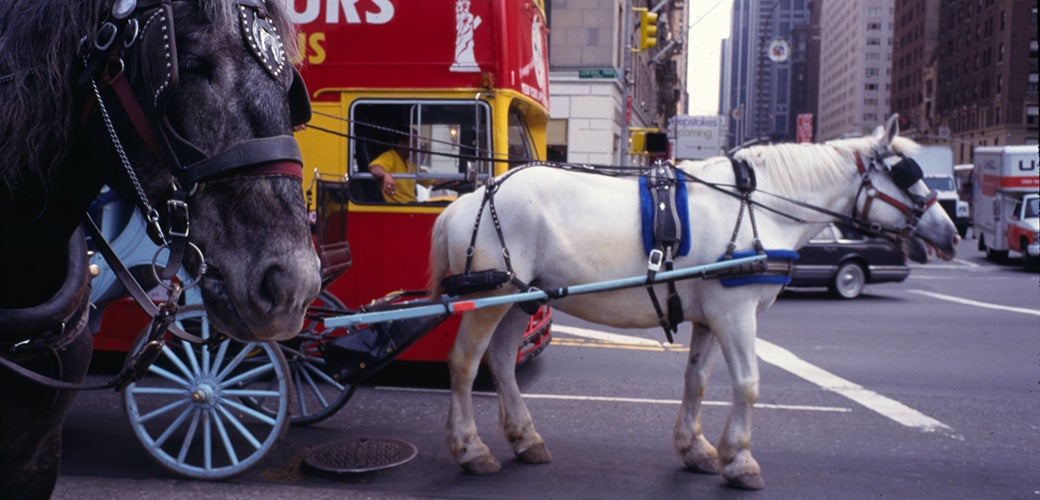
Following decades of debate, repeated accidents, incremental reforms and renewed public concern, on October 22, 2026, the New York City Council passed Romanch's Law, formerly Ryder's Law, to phase out horse-drawn carriage operations in New York City.
Romanch’s Law will take effect on June 1, 2028, creating a two-year transition period designed to protect horses and the public while supporting a fair path forward for workers whose livelihoods are connected to the industry.
Yes. The ASPCA has worked to protect horses since our founding in 1866, advocating for stronger regulations and oversight to protect working horses as well as for a full ban to get horse-drawn carriages off our hometown’s increasingly congested streets. While regulations can improve certain aspects of horse care and management, experience has shown that regulation cannot overcome the fundamental challenges of operating horse-drawn carriages in a modern, urban environment like New York City. The risks to horses, workers, passengers and the public are not simply the result of insufficient oversight; they are built into the activity itself.
Yes. Both Mayor Zohran Mamdani and City Council Speaker Julie Menin supported Romanch’s Law, publicly acknowledging the need to end horse-drawn carriage operations while ensuring a fair transition for affected workers. The measure was also supported by the Central Park Conservancy, other elected officials, public safety advocates and members of the public who increasingly expressed concern regarding the continued operation of horse-drawn carriage services.
Romanch’s Law creates a two-year transition period and is set to take effect on June 1, 2028. During that time, city agencies and the horse-drawn carriage industry will work to responsibly phase out carriage operations.
This period is intended to support the humane retirement and placement of carriage horses as well as the creation of a workforce transition program for carriage drivers and stable workers.
If horse owners need assistance safely rehoming their horses, the ASPCA is prepared to support humane placement, including by tapping into our network of equine rescue partners and providing resources or grant funding where needed. Additionally, a coalition of equine rescues, sanctuaries, retirement organizations and welfare groups have also offered their support.
ASPCA research shows that 2.3 million Americans have both the interest and resources to adopt a horse, pointing to a strong pool of potential adopters for horses who need safe, appropriate homes.
No. New York State law prohibits the sale of horses for slaughter, so claims that carriage horses will be sold to slaughter are not accurate. Our research shows there are more than enough potential homes for these horses if they are given the opportunity to be rehomed. In addition, the ASPCA is one of many organizations that has offered support, including grant funding and other resources, to help identify safe rehoming options should owners need assistance.
Yes. New York City is not alone in making this change. Other U.S. cities, including Chicago, Philadelphia and Salt Lake City, have ended or prohibited traditional horse-drawn carriage operations. Major cities around the world, including London, Paris, Toronto, Barcelona, Montreal and Beijing, have also limited or ended these operations in busy urban centers.