
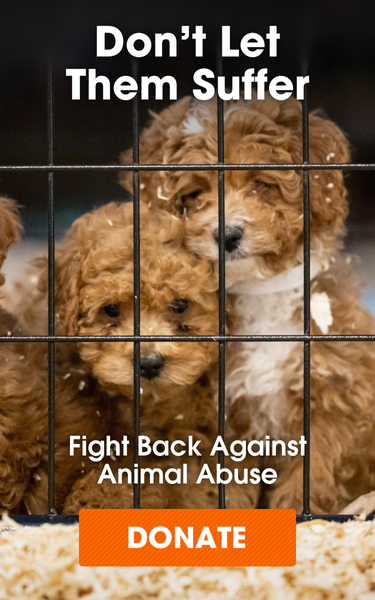
At any given time, over a million vulnerable animals are languishing in U.S. Department of Agriculture (USDA)-licensed facilities, including commercial dog-breeding operations known as puppy mills. The Animal Welfare Act is the federal law designed to protect these animals, but the USDA is failing to enforce even its most basic provisions, such as ensuring animals have access to clean food and water, clean and safe housing and veterinary care. There are three bipartisan bills before Congress that would address the USDA’s failures and protect dogs who are suffering: Goldie’s Act (H.R. 349), Better CARE for Animals Act (H.R. 3112/S. 1538) and Puppy Protection Act (H.R. 2253).
Anyone who cares about animals would want to pass these bills and fix this broken system. Yet, a handful of industry groups, including the American Kennel Club (AKC), have routinely lobbied to kill these bills thereby keeping dogs in inhumane commercial breeding operations.
The AKC has formed a public image as a champion for dogs but make no mistake — it is not an animal welfare organization. Its mission is to promote the breeding of purebred dogs. It relies on profits from breed registrations, and every puppy bred creates the potential for the AKC to earn another registration fee. Keeping puppy mills running benefits the AKC financially, which is why it refers to breeders as “clients.” This sad reality motivates the AKC to prioritize profits over the welfare of dogs and oppose legislation that would protect dogs and close cruel puppy mills.
To be clear: The AKC’s lobbying strategy does not align with the American public. The majority of Americans want Congress to do more to protect animals, and 88% of Americans want their members of Congress to support Goldie’s Act.
Here’s the truth:
The AKC claims it supports holding bad breeders accountable.
Fact: The AKC consistently opposes bills that would hold bad breeders accountable and wants to make it harder to help dogs who are suffering in puppy mills. The AKC supports misguided legislation that would raise the USDA’s threshold for removing animals who are suffering to only removing animals in a state of “unrelieved suffering,” making it highly unlikely that injured animals will receive aid. This legislation would also allow the USDA to shirk its responsibilities by needing to merely “consider” removing a suffering animal rather than requiring the animal’s removal. Yet, time and time again we have seen the deadly consequences of the USDA’s inaction.
The AKC claims it believes in stronger enforcement of existing animal welfare laws.
Fact: The AKC opposes Goldie’s Act, which would do exactly that. Goldie’s Act would strengthen enforcement of the Animal Welfare Act by requiring the USDA to conduct better inspections of federally licensed facilities, document all Animal Welfare Act violations, assess each violation for a penalty, timely notify state and local law enforcement of violations and remove suffering animals — all authorities the agency already has but too often fails to use. The AKC’s opposition to Goldie’s Act is antithetical to its claim of believing in stronger enforcement of existing laws.
The AKC claims that if Goldie’s Act passes, it would be too easy for the USDA to remove suffering animals.
Fact: It’s hard to sympathize with the argument that the USDA shouldn’t remove animals who are suffering. On the contrary, the USDA shouldn’t be allowed to let animals languish and die while it waits to see if a licensee will address the issue.
The truth is that the USDA already has the authority to remove suffering animals but fails to use it even in the most cruel and inhumane situations, as in Goldie’s story. In fact, the USDA has not removed a single dog from any facility in the past five years despite documented cases of dogs who are unable to walk, dogs suffering from heat stroke, emaciated dogs and dogs dying from untreated diseases. This is unacceptable. Goldie’s Act would require the USDA to remove any suffering animals so they can receive veterinary care if a facility is unwilling or unable to do so.
The AKC claims that Goldie’s Act would treat minor paperwork violations the same as severe animal cruelty violations.
Fact: Goldie’s Act would require inspectors to document all violations, but that doesn’t mean the agency will penalize the licensee identically for each violation. Prior to issuing a license, the USDA thoroughly educates applicants on expectations and consequences for licensure. The licensee agrees to provide the minimal standards of care required under the law. If a licensee fails to meet those standards, then Goldie’s Act would require a USDA inspector to document the violation, and then USDA would assess what penalty, if any, might be appropriate based on various factors, such as severity or past violation history. This would ensure that violators are held accountable under existing law and bad actors are penalized accordingly.
The AKC claims thatGoldie’s Act would allow for immediate seizure or euthanasia of animals suffering from “psychological harm,” which it does not define.
Fact: USDA inspectors are trained to determine if an animal is suffering and to document whether Animal Welfare Act standards are being met. Psychological harm can often be clearly demonstrated by observing compulsive, stress-induced movements like obsessively spinning in circles or self-mutilation. These dogs deserve to be helped just like other dogs who are suffering from visible wounds. Ultimately, the USDA has the responsibility to ensure the welfare of animals in regulated facilities.
The AKC claims that Goldie’s Act would hurt small, home-based breeders.
Fact: The Animal Welfare Act only applies to commercial operations — those that breed four or more dogs for the pet trade or research — and Goldie’s Act does not change that. Breeders who sell their puppies directly to families looking for a pet will remain unaffected.
The AKC claims that Goldie’s Act violates the property rights of commercial breeders by allowing the removal of suffering animals.
Fact: In order to obtain a USDA license, breeders agree to provide minimal standards of care to animals and agree that failing to provide those standards of care could result in penalties, including the removal of suffering animals.
Being a USDA-licensed breeder under the Animal Welfare Act is a privilege, not a right, and a license can be suspended or revoked if a breeder fails to comply with the law. If a breeder is violating the law and dogs are suffering, the USDA should remove the animals.
We call on lawmakers to pass Goldie’s Act and ensure that the purpose and intent of the Animal Welfare Act — to protect animals against inhumane treatment — is achieved, and that animals receive the full protection they are due under federal law. Learn more about Goldie’s Act and its wide range of supporters.